





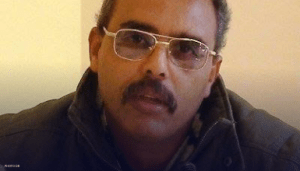
The defining moment of his journey is linked to the Gdeim Izik camp, established in October 2010 by Sahrawis wishing to express their social and political grievances. On 25 December 2010, Sid’ Ahmed Lemjeyid was detained by Moroccan police officers in plain clothes in El Aaiun. After his arrest, he was transferred to an unknown location where he allegedly underwent violent interrogations and acts of torture. According to his lawyers, these interrogations — which lasted several days — focused primarily on political questions, with no direct reference to the Gdeim Izik camp, underscoring the authorities’ intent to break any form of resistance. ]Sid’ Ahmed Lemjeyid is a political prisoner and Sahrawi human rights and environmental defender, born in 1959. He is the President of the Committee for the Protection of Natural Resources in Western Sahara (CSPRON), an organisation committed to protecting and managing the natural resources of this region — rich in phosphates, fisheries, and water resources. Western Sahara is a disputed territory, the political status of which has been at the root of a conflict lasting decades — primarily between Morocco, which considers Western Sahara an integral part of its territory, and the Polisario Front, the representative of the Sahrawi people. This conflict has repercussions not only on a political level, but also on human rights and the management of natural resources in the region.
The defining moment of his journey is linked to the Gdeim Izik camp, established in October 2010 by Sahrawis wishing to express their social and political grievances. On 25 December 2010, Sid’ Ahmed Lemjeyid was detained by Moroccan police officers in plain clothes in El Aaiun. After his arrest, he was transferred to an unknown location where he allegedly underwent violent interrogations and acts of torture. According to his lawyers, these interrogations — which lasted several days — focused primarily on political questions, with no direct reference to the Gdeim Izik camp, underscoring the authorities’ intent to break any form of resistance.
On November 8, 2010, a police operation was carried out to evacuate the Gdeim Izik camp, drawing international attention and triggering violence. Sid’ Ahmed Lemjeyid maintains that he was not present in the camp that day, stating that he had only visited it as a human rights activist to speak with people about their demands and their suffering. On February 17, 2013, a Moroccan military tribunal in Rabat sentenced him to life imprisonment. This sentence was upheld by the Salé Court of Appeal on July 19, 2017. On 16th September 2017, all members of the Gdeim Izik group, including Lemjeyid, were transferred to various prisons across Morocco. Sid’ Ahmed was sent to Ait Mellou Prison, located 600 km from El Aaiun, thereby separating the prisoners from their families and potential support networks. He claims to have signed confessions under duress and has consistently denied any connection to the Gdeim Izik camp, stressing that he had been arrested because of his status as a Sahrawi activist raising public awareness of the environmental and social issues linked to the exploitation of natural resources in the region. In November 2023, the UN Working Group on Arbitrary Detention issued an opinion holding that the imprisonment of the 18 Sahrawis making up the Gdeim Izik group — including Lemjeyid — has no legal basis and is contrary to Articles 3 and 9 of the Universal Declaration of Human Rights, and therefore constitutes arbitrary detention. On this occasion of the 2026 Night of Vigil, ACAT-France reaffirms its opposition to life imprisonment — a sentence that raises important questions in terms of human rights and is considered contrary to the right to rehabilitation and social reintegration. International conventions, such as the International Covenant on Civil and Political Rights (ICCPR), to which Morocco is a party, insist on respect for human dignity, even for those who have committed crimes.
To write to him :
ACAT-France
7 Georges Lardennois
75019 Paris
L’ACAT will forward your letters

